

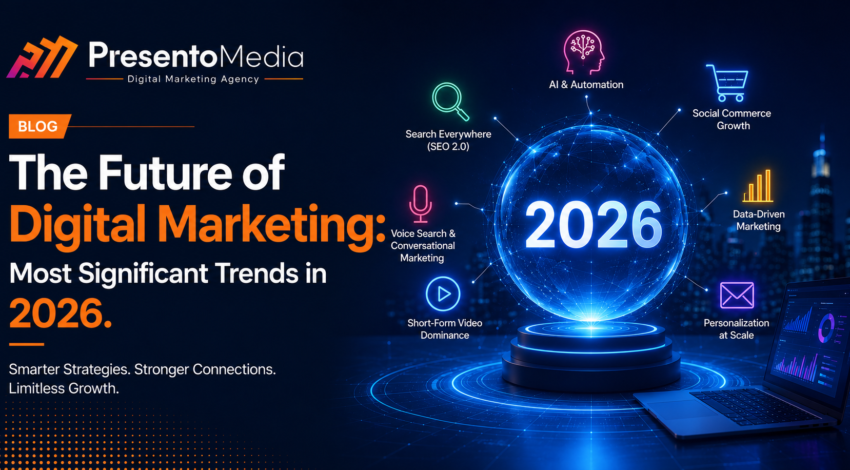
Digital space is changing at a pace like never before, and those companies that fail to change will be left behind. As far as artificial intelligence advances incredibly fast and data privacy policies are evolving, digital marketing in 2026 will have a totally different appearance compared to what we can recognize today. The brands are forced to keep abreast of these changes in order to be competitive, relevant, and profitable.
We discuss the most significant trends of digital marketing that 2026 will introduce in this blog and how companies will need to adjust to the future of online marketing.
Artificial intelligence marketing is the new reality.
Artificial intelligence is already not a choice anymore; it is the foundation of contemporary marketing. AI is changing the way marketers work, both in developing content and predicting analytical results, as well as chatbots and optimizing advertisements.
The digital marketing strategies of 2026 will allow hyper-personalization using the AI-powered tools that will conduct an analysis of customer behavior in real time. The companies will be in a position to create custom-made content, emails, and advertisements, depending on their preferences, which enhance their rates of engagement and conversion.
Hyper-Personalization of First-Party Data.
As the stricter regulations on the use of third-party cookies continue, brands will transition to first-party data collection. This will change the future of digital marketing, and the importance of trust and transparency is going to become significant.
Marketers will depend on CRM systems, interactions on websites, and customer consent-based data to provide meaningful experiences in 2026. Individual landing pages, product suggestions, and email campaigns will not only be a norm but also a standard feature.
Search Generative AI and Zero-Click Results.
Search engines are evolving at a high pace, and the advent of AI-enhanced search experiences is happening. Zero-click searches have become more frequent as users get answers to their search queries without necessarily clicking on the sites.
Under the new trend of digital marketing, the SEO strategies will be aimed at the topical authority, structured data, and the content that should be presented in the search results of the AI. The brands will be required to optimize not only on rankings but also on visibility in AI summaries and voice-based search.
Short and Interactive Video Preeminence.
The video content is still going to keep user attention, but this time, it will be more interactive and more immersive than ever in the year 2026. Brief videos, live shows, shoppable videos, and storytelling will play a significant part in attracting on platforms.
Video-first investments will be necessary for businesses that will have to adjust to the trends of digital marketing in 2026. The brands that use the authentic and value-based video material will outshine those, that use only static media.
Audio and Visual Search Optimization.
Voice search will be a vital aspect of digital marketing in 2026, with the further integration of smart devices and voice assistants. Conversational queries are employed by consumers, and they need content and keywords optimization in a different manner.
The visual search is also taking off, particularly in e-commerce. Image optimization, descriptive alt text, and schema markup will be important aspects of the future-friendly search engine optimization.
First, marketing and ethical branding.
Customers are becoming conscious of the use of their data. To this, privacy-first marketing will become among the most significant digital marketing strategies in 2026.
Groups with greater confidence will trust ethical brands that have fair policies and safe websites. Marketing communications will be more concerned with values and sustainability and true to authenticity, as opposed to aggressive selling strategies.
The trends in influencer marketing are moving to micro- and nano-influencers.
Influencer marketing is taking the form of a new direction from celebrity endorsement to genuine creator collaborations. In the digital marketing future, micro- and nano-influencers with niche audiences will be significant.
In many instances of these influencers, the engagement rate and trustworthiness are higher than the large-scale influencers. The brands will prioritize long-term partnerships rather than single promotion, which will guarantee continuity in brand storytelling.
Smart Campaign Management and Automation.
Marketing automation is increasingly becoming sophisticated and smart. In 2026, the email campaigns, social media scheduling, ad bidding, and customer segmentation will be controlled by automated workflows with minimum human intervention.
Automation will not remove marketers but give them the capability to think creatively, strategize, and engage with customers well in businesses that have embraced the new trends in digital marketing.
Omnichannel Customer Experience.
Brands are experiencing consumer contact on multiple platforms: websites, social media, email, messaging apps, and face-to-face interactions. A fluid omnichannel experience will be a fundamental need of digital marketing in 2026.
Brands will combine all the touchpoints with the customers into a single experience, and all channels will be consistent in their messages and personalized communication.
Conclusion
AI, personalization, privacy, and immersive experiences are the shapers of the digital ecosystem in 2026. Companies that adopt such digital marketing trends by 2026 will have a competitive advantage, and companies that are slow to adapt to change are likely to become redundant.
The future of digital marketing is not about the new tools, but rather about reconsidering the way brands relate with their audiences. Through intelligent, ethical, and customer-oriented strategies of digital marketing in 2026, companies will be able to develop sustainable growth and significant online relations.


